Get free guidance and exclusive deals to grow your business with business.com+
Join Free
BND Hamburger Icon

Menu

Close
BND Logo
Search Icon
Search Icon
Advertising Disclosure
Close
Advertising Disclosure

Business News Daily provides resources, advice and product reviews to drive business growth. Our mission is to equip business owners with the knowledge and confidence to make informed decisions. As part of that, we recommend products and services for their success.

We collaborate with business-to-business vendors, connecting them with potential buyers. In some cases, we earn commissions when sales are made through our referrals. These financial relationships support our content but do not dictate our recommendations. Our editorial team independently evaluates products based on thousands of hours of research. We are committed to providing trustworthy advice for businesses. Learn more about our full process and see who our partners are here.

The Best CRM Software for Real Estate

author image
Written by:
Mark Fairlie, Senior Analyst
Gretchen Grunburg headshot
Editor verified:
Gretchen Grunburg,Senior Editor
Last Updated Sep 18, 2026
Business News Daily earns commissions from some listed providers. Editorial Guidelines.
9.3 /10
Editor's rating
Best for Lead Generation
  • Social media ads
  • Automated email drip campaigns
  • Precise list segmentation
Visit Site
Links to HubSpot CRM
Salesforce company logo
Salesforce CRM
9.5 /10
Editor's rating
Best for Customer Communication
  • Excellent buyer/seller segmentation
  • Event-based automated communication
  • Pre-built real estate apps
monday sales CRM logo
monday Sales CRM
9.5 /10
Editor's rating
Best for Growing Real Estate Businesses
  • Standardized team workflows
  • Customizable deal pipelines
  • Mobile app
Zoho CRM logo
Zoho CRM
9.2 /10
Editor's rating
Best for Lead Nurturing
  • Automated lead follow-up
  • Free plan for up to three users
  • Omnichannel client follow-up


Table Of Contents Icon

Table of Contents

Open row

When choosing the best CRM software for real estate agents, our team of small business experts researched both the real estate and CRM software markets. We attended live demonstrations of CRM platforms and then tested them out for ourselves to see which best fit the needs of real estate agents. We looked for CRMs that made it easy to generate and nurture leads for buyers and sellers, as well as communicate directly with them and arrange showings. We also looked for tools that seamlessly integrated with document management tools so real estate agents could streamline the paperwork process needed to close a deal. Finally, we gathered real-life customer feedback about each platform to see how users’ experiences lined up with our testing experience. Learn more about our methodology.

How We Decided

How We Decided

Real estate firms have specific needs when choosing CRM software. According to the National Association of Realtors, 81 percent of real estate firms operate from a single office. With smaller teams in mind, we looked for CRM platforms...

Read MoreRead More

Real estate firms have specific needs when choosing CRM software. According to the National Association of Realtors, 81 percent of real estate firms operate from a single office. With smaller teams in mind, we looked for CRM platforms that make it easy to manage leads, stay in touch with buyers and sellers and keep deals moving without adding unnecessary complexity.

We considered 65 CRM platforms and closely reviewed and tested 25 before selecting the four best suited to real estate professionals. We paid particular attention to lead generation and nurturing, client communication, workflow automation and mobile functionality. We also considered ease of use, real estate integrations and what businesses actually have to pay to access the features they’ll need.

65

considered

25

reviewed

4

selected

Real estate firms have specific needs when choosing CRM software. According to the National Association of Realtors, 81 percent of real estate firms operate from a single office. With smaller teams in mind, we looked for CRM platforms that make it easy to manage leads, stay in touch with buyers and sellers and keep deals moving without adding unnecessary complexity.

We considered 65 CRM platforms and closely reviewed and tested 25 before selecting the four best suited to real estate professionals. We paid particular attention to lead generation and nurturing, client communication, workflow automation and mobile functionality. We also considered ease of use, real estate integrations and what businesses actually have to pay to access the features they’ll need.

65

considered

25

reviewed

4

selected

The right customer relationship management (CRM) system is essential for Realtors who want to stand out in a crowded marketplace and deliver best-in-class service to their clients. The best CRM software helps real estate professionals find buyers, arrange property showings, handle negotiations, manage mountains of paperwork and guide each deal to completion. CRM solutions keep you organized and streamline the complexities of buying and selling property. Many platforms offer AI and automation tools that can help with time-consuming tasks like drafting messages, following up with leads and summarizing client interactions. We’ve reviewed dozens of CRM platforms and analyzed their features and functionalities to pinpoint the CRM solutions that best fulfill the needs of real estate professionals.

Compare Our Best Picks

BND Ribbon
Our Top Picks for 2026
HubSpot CRM
Salesforce CRM
monday Sales CRM
Zoho CRM
Rating9.3/109.5/109.5/109.2/10
Best use case

Lead generation

Customer communication

Growing real estate businesses

Lead nurturing

Starting price (paid plans)
  • Smart CRM: Paid plans start at $45 per seat per month with annual billing
  • Sales Hub: Paid plans start at $20 per seat per month with annual billing

$25 per user per month (billed monthly or annually)

$36 per month (three-user minimum, $12 per user; billed annually)

$14 per user per month (billed annually

Free trial for paid plans

14 days on select paid plans

30 days

14 days

15 days

Free service tier

Yes

Yes (Free Suite, up to two users)

Yes (work management platform only)

Yes (up to three users)

Customer support

24/7 email and chat; phone support on higher-tier plans

Knowledge base and community standard; 24/7 phone, email and chat for business-stopping issues with the Premier Success Plan

24/7 by live chat and email on all plans

Email, phone and live chat included with paid plans; 24/7 support available as an upgrade

Realtor-related apps

Limited — some real estate-specific apps in a large marketplace

Extensive — a dedicated real estate category on AppExchange, including property and brokerage platforms

Moderate — dedicated real estate solutions and templates, plus customizable CRM workflows

Modest — a handful of real estate extensions in Zoho Marketplace, plus its own industry templates

Review Link
Scroll Table
Hubspot company logo
Editor's Rating: 9.3/10
Visit Site
Links to HubSpot CRM

HubSpot is an excellent CRM platform for Realtors who want to boost their marketing efforts. In a few short steps, you can generate new leads from the platform via email campaigns, social media ads and form submissions. HubSpot helps you establish a presence on the communication channels that buyers and sellers use most and personalize your outreach to increase the chance of a conversion.

We were particularly impressed by HubSpot’s management of social media marketing campaigns, which is a crucial tool for real estate marketing. HubSpot can help you create and launch advertising campaigns on Meta (Facebook) and TikTok to grab your target audience’s attention, and a LinkedIn integration can help those who sell commercial real estate. HubSpot’s AI tools help craft personalized ads in minutes, and a central CRM dashboard ensures that your messaging is consistent — something that is essential for building brand recognition and trust.

We also like that HubSpot’s insights reveal which campaigns are working and which ones aren’t hitting the mark, while the platform’s ability to analyze buyer intent can help you identify prospects that are most likely to convert. This information can help you restructure your marketing efforts until you find an approach that resonates with your target clients.

HubSpot’s lead-capture system impressed us, too. It lets you set up a live AI chatbot on your site and connect your website forms to the platform; when someone makes an inquiry, a new customer record appears in your system. What’s more, HubSpot’s AI can help streamline form submissions across all channels to ensure consistent CRM data input for more effective follow-ups. You can set up entire automated workflows to nurture new leads or prompt agents to reach out moments after submission to impress potential customers before your competitors do.

HubSpot offers several products, so real estate businesses should consider which tools they actually need. Many agencies may find that Smart CRM, Sales Hub or a combination of HubSpot products provides enough functionality for managing leads and client relationships. Businesses that need more advanced marketing automation may want Marketing Hub Professional, but that’s a significant jump in price. It starts at $800 per month with annual billing and requires a $3,000 onboarding fee.

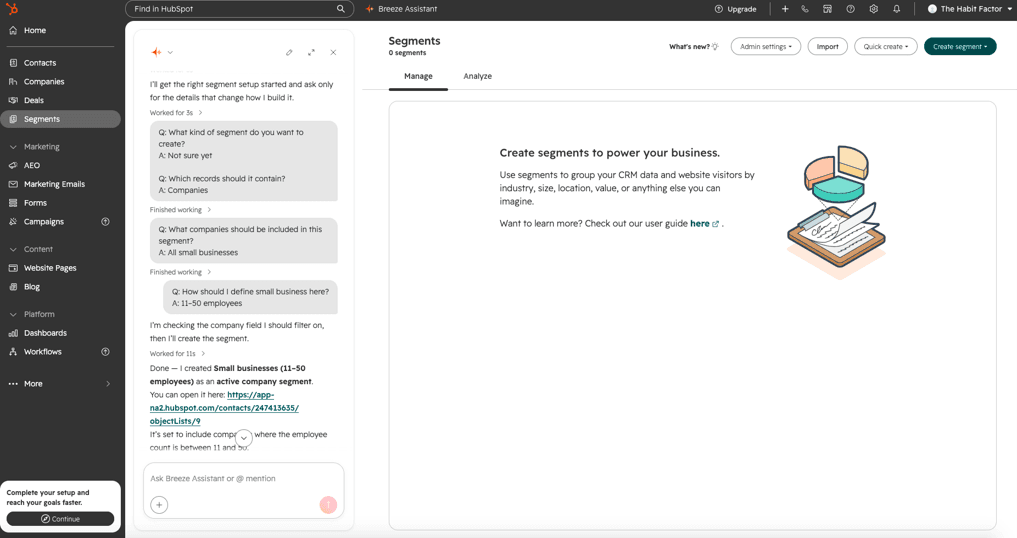
HubSpot CRM's Breeze Assistant creating an active company segment based on employee count

We used HubSpot’s Breeze Assistant to create an active segment of small businesses using a conversational prompt. Segments can help businesses organize prospects for more targeted marketing and follow-up. Source: HubSpot

  • HubSpot can capture leads through website forms and chat, automatically adding new prospects to the CRM for follow-up.
  • Detailed campaign insights help real estate professionals see which marketing efforts are generating interest and adjust their outreach accordingly.
  • HubSpot has several products and pricing structures, and costs can rise considerably if your real estate business needs more advanced sales or marketing tools.

HubSpot CRM holds a rating of 8.4 out of 10 on TrustRadius. Many reviewers like how easy the platform is to use, along with the range of marketing tools available. Reporting is a sticking point for some users, though, particularly when they want more flexibility or customization.

Salesforce company logo
Editor's Rating: 9.5/10

Keeping in touch with clients is challenging, especially when real estate agents are juggling multiple deals. Salesforce’s client communication tools excel in streamlining and improving the quality and efficiency of buyer and seller interactions.

We were impressed by how easily Salesforce segments clients according to various preferences; this feature is excellent for targeted email outreach campaigns. For example, when a listing appears in a particular school district, you can immediately email buyers who are interested in that area. Or, if you have clients who want a quick sale, you can email them tips for making their property more appealing.

We particularly appreciated how Salesforce’s generative AI can help craft personalized emails based on previous contact history and communication, which helps build stronger client relationships. Salesforce also offers Agentforce, which can pull information from CRM records and help agents quickly surface important details about a client or account. Einstein Activity Capture can sync email and calendar activity with CRM records, while Einstein Conversation Insights can analyze customer calls and identify details like sentiment and follow-up tasks.

We also liked Salesforce’s smart communication automations. For example, the system can notify agents about a new website lead for a prompt follow-up or trigger an automated email to a buyer who just attended a viewing to garner their feedback. You can also trigger email updates to keep buyers and sellers in the loop when a deal moves to the next stage.

Salesforce allows you to contact clients by phone, email, text message and even Slack. The platform keeps customer interactions and activity connected to CRM records, giving agents a shared view of each client’s history. Salesforce’s conversation intelligence tools can also analyze calls and surface useful information for follow-ups. All agents can quickly access a client’s history to avoid repetitive conversations and provide timely support.

One advantage for very small real estate businesses is Salesforce’s Free Suite, which supports up to two users and includes sales, marketing and service tools along with built-in AI. Salesforce also has real estate-specific apps on AppExchange, allowing businesses to add property and brokerage functionality that isn’t built into the core CRM.

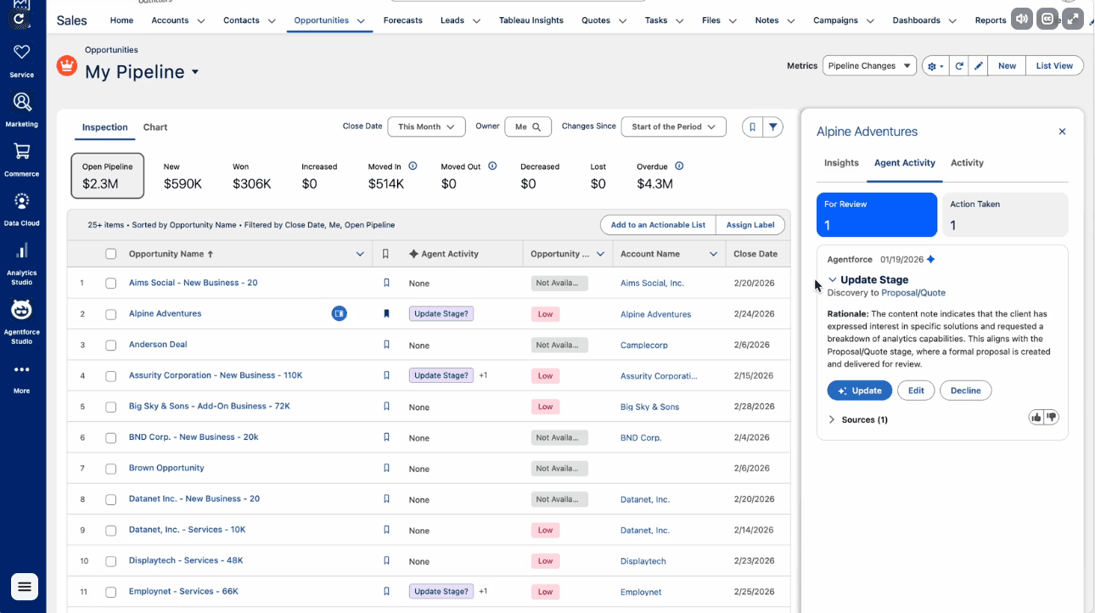
Salesforce CRM opportunity pipeline showing an Agentforce recommendation

Salesforce gives users a detailed view of their opportunity pipeline. Here, Agentforce recommends updating an opportunity stage based on information in the CRM. Source: Salesforce

  • Salesforce can segment buyers and sellers by their preferences, making it easier to target the right clients with listings and other outreach.
  • Real estate-specific apps on AppExchange let agencies add property and brokerage functionality to the CRM.
  • Salesforce's extensive functionality and customization options can take time to learn, particularly for smaller teams.

Salesforce CRM earns 8.8 out of 10 on TrustRadius, where the platform is listed as Salesforce Agentforce Sales (formerly Salesforce Sales Cloud). Reviewers appreciate the platform’s extensive functionality and customization options, including the ability to adapt it to different workflows. Some users find Salesforce complex, though, particularly when setting up and managing its many features.

monday sales CRM logo
Editor's Rating: 9.5/10

monday CRM is an excellent tool for Realtors who are scaling up their agencies. The flexible workflow automations allow you to roll out the same processes and procedures at every location. Save your staff time by automating essential but repetitive tasks, like assigning leads and sending follow-up emails. These automations improve efficiency at every location and help you maintain control over your processes. Better still, your customers get a consistent, high-quality experience no matter which branch they visit.

We were impressed that monday uses Kanban views to help staff manage deal flows and visualize where individual sales are in the sales pipeline. Real estate teams can customize stages and fields to match their own processes, including property details and offer information. Owners and managers can check these views anytime to ensure that team members at every branch do everything possible to close deals.

With monday’s unified database, it’s easy to sync existing and new contacts. Thanks to mobile CRM capabilities, on-the-go agents can update client information via the mobile app, which is as full-featured and easy to use as the desktop dashboard. Everyone in your agency can access accurate, real-time information.

The platform excels in CRM analytics and performance tracking, letting you monitor real-time CRM metrics across the business and by branch to make data-driven decisions that improve company performance. Real estate teams can also track pipeline value and close rates by agent, team or lead source, which is particularly useful as an agency grows.

monday CRM also offers a growing collection of AI tools that can take repetitive work off agents’ plates. Its AI agents can qualify leads, prepare agents for meetings and help keep CRM records up to date, while AI Notetaker captures meetings and generates summaries and action items. We like that these tools work directly with the CRM’s existing deals, contacts and pipeline data. However, businesses should keep an eye on AI usage: Some monday CRM AI features consume credits, and the number used varies by feature and task.

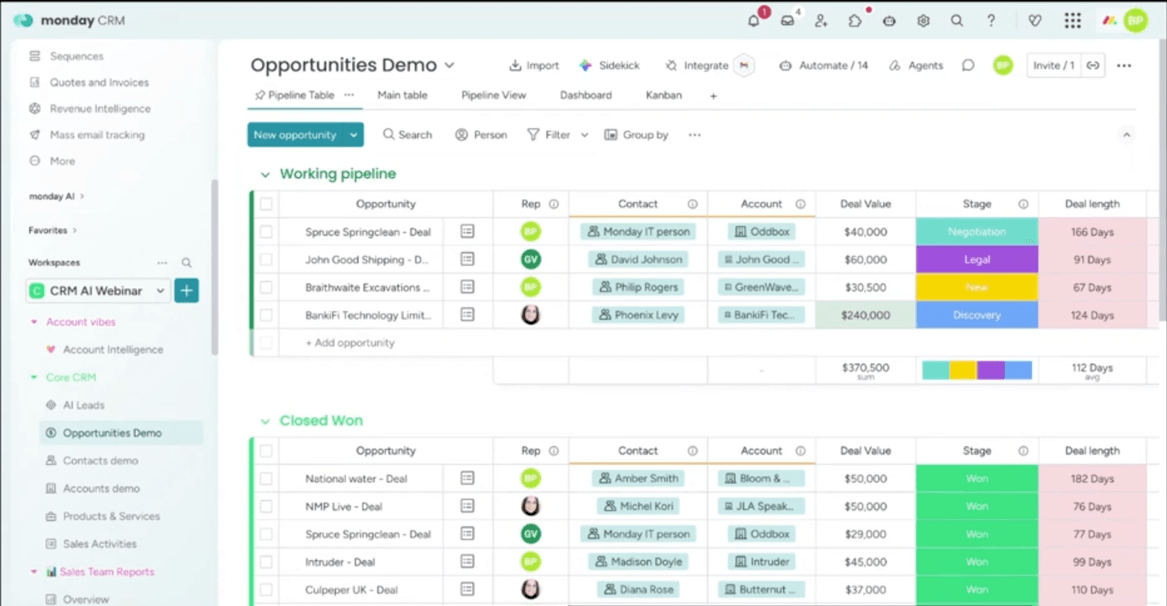
monday CRM opportunity pipeline showing deal values, stages and closed deals

monday CRM gives teams a detailed view of active and closed opportunities. In this demo, users can track each deal’s assigned rep, contact, account, value, stage and length. Source: monday CRM

  • monday CRM lets real estate teams customize deal stages and fields to match their own sales processes, including property and offer details.
  • Its AI tools can qualify leads, prepare agents for meetings and turn conversations into summaries and action items.
  • Paid plans require a minimum of three seats, which may make monday CRM less practical for solo agents and very small real estate businesses.

monday CRM scores 8.1 out of 10 on TrustRadius. Reviewers like the platform’s automation capabilities, customization and tools for keeping projects and tasks organized. Some users find more advanced automations difficult to set up, while others point to monday’s pricing structure as a drawback as their teams grow.

Did You Know?Did you know
Competition is fierce in the real estate sector. According to the National Association of Realtors, 81 percent of real estate firms operate out of a single office, with an average of two full-time real estate agents on staff — down from three in 2023.
Zoho CRM logo
Editor's Rating: 9.2/10

Nobody buys a house on the first phone call. A prospect who walks an open house in March may not be ready to make an offer until autumn, and the agent who is still politely in touch when that moment arrives has a much better shot than one who disappeared months ago. That is the specific problem Zoho CRM handles particularly well, which is why it is our pick for lead nurturing.

What we like most is Zoho’s Cadences, which let you lay out a sequence of touches — an email now, a market update in three weeks, a check-in call after that — and then automate much of the follow-up, pausing automatically when a prospect replies so nobody gets a canned message in the middle of a real conversation. Paired with Zoho’s Blueprints, which walk a record through your defined follow-up stages and can require specific actions before it advances, you get something closer to an enforced process than a set of reminders. For an agency where marketing automation has historically meant one person remembering to send emails, that is a meaningful upgrade.

We were also struck by how accessible these tools are for a small real estate office. Cadences are available starting with the Standard plan, while Blueprints are included with Professional. Zoho’s free tier covers up to three users, which gives a very small agency room to manage a real pipeline without immediately moving to a paid plan. We appreciate that Zoho brings email, phone, live chat and social communication into the CRM, too, so agents can keep track of prospect interactions across multiple channels.

You can also set up CRM workflows for routine parts of a transaction — inspection scheduling, document requests and post-closing check-ins — so agents don’t have to remember every follow-up themselves. Blueprints can take that structure further by requiring tasks, meetings, calls, notes or documents at particular stages of a process.

Where we were disappointed is the AI. Zoho offers some AI functionality on lower-tier plans, but its extended Zia capabilities require Enterprise. That creates a notable price jump for agencies that want more advanced AI alongside Zoho’s already strong automation tools. For lead nurturing, though, we think the platform’s Cadences, Blueprints and workflows are the bigger draw.

  • Zoho CRM's free plan supports up to three users, making it accessible for very small real estate teams.
  • Email, phone, live chat and social communication can be managed through the CRM, helping agents keep track of prospect interactions across multiple channels.
  • Keap's pricing, which starts at $159 monthly for two users, might put this platform out of reach for some real estate businesses.

Zoho CRM holds a rating of 8.4 out of 10 on TrustRadius. Reviewers like the platform’s customization options, affordability and integrations with other Zoho products. Some users find the software complicated to set up, though, particularly when configuring workflows and custom modules.

TipTip
Before setting up a Cadence, decide when a lead should be considered inactive. Keeping unlikely prospects in active sequences can clutter your contact lists and make CRM metrics less useful when you’re evaluating your lead-nurturing efforts.

Costs of Real Estate CRMs

CRM system costs for your real estate business will vary widely depending on your agency’s size and needs. While you may be able to start with a free option, growing and more established real estate agencies will likely need higher-level features.

Our top CRM systems for real estate incur the following costs:

ProviderNumber of paid tiersLeast-expensive paid optionMost-expensive paid option
HubSpot (Sales Hub and Smart CRM)3 (Sales Hub)

2 (Smart CRM)

Sales Hub Starter: From $20 per user per month

Smart CRM Professional: From $45 per user per month

Sales Hub Enterprise: From $150 per user per month

Smart CRM Enterprise: From $75 per user per month

Salesforce CRM2Starter Suite: $25 per user per month (paid monthly or annually)Pro Suite: $100 per user per month (paid annually)
monday CRM4Basic: $36 per month for three users (paid annually)Ultimate: Call for a quote
Zoho CRM4Standard: $14 per user per month (paid annually)Ultimate: $52 per user per month (paid annually)

There are a few additional costs and pricing quirks to keep in mind as you compare real estate CRM systems:

  • Product lines can get complicated: CRM providers often sell multiple products, suites and plans with overlapping features, so make sure you’re comparing the right offerings. Salesforce is a good example. For this comparison, we’re focusing on its small business CRM lineup: Free Suite, Starter Suite and Pro Suite. Businesses that need more advanced sales capabilities can also consider Salesforce’s more expensive Agentforce Sales offerings, which have their own pricing and features.
  • Promotional pricing can make starting prices tricky: Some CRM providers offer introductory discounts or limited-time pricing to new customers. For example, at the time of this writing, HubSpot’s Sales Hub Starter was being advertised for $7 per seat per month. These offers can make a plan look considerably less expensive than its standard rate, so check what you’ll pay once the promotional period ends. When possible, we use standard pricing in our comparisons rather than temporary promotional rates.
  • Apps and integrations can add to your monthly costs: All four of our picks have marketplaces or integrations that can expand the CRM’s functionality. Some real estate-specific property and brokerage apps require their own subscriptions, so the amount you pay per CRM seat may be only part of your total software cost.
  • Onboarding and premium support may cost extra: Some higher-tier products require paid onboarding. For example, HubSpot’s Sales Hub Professional has a $1,500 onboarding fee, while Marketing Hub Professional requires $3,000. Zoho’s optional Premium Support costs 20 percent of the subscription fee, while Salesforce’s Premier Success Plan costs 30 percent of net license fees. Consider these expenses if your team will need more help getting started or ongoing support.
  • AI costs aren’t always included in the subscription price: Some vendors use credits or usage-based pricing for certain AI features. That can make your monthly costs harder to predict as your team starts using AI more heavily. Before signing up, find out which AI tools are included in your plan, how usage is measured and what you’ll pay if you exceed the included allowance.

Features of Real Estate CRMs

CRM platforms have a broad range of features that can handle numerous and complex business needs. For real estate agencies specifically, the following features are must-haves.

Marketing

According to the Association of Real Estate License Law Officials, its license verification service provides access to records for more than 2.9 million real estate licensees. Marketing is crucial in such a competitive industry, and your CRM should have extensive marketing features that help your brand stand out.

At the very least, ensure your platform offers must-have CRM integrations, such as social media integrations and integrations with tools that streamline email marketing. Consider a platform that provides a live chatbot that allows you to capture contact details on your website.

TipTip
It’s helpful if your CRM offers integrations with Google Ads and other paid search advertising platforms that can help you appear in local searches.

Lead Management

CRM systems are crucial for lead management because they centralize customer data. For the best results, migrate your existing data into your CRM immediately. Then, synchronize the CRM with your other business apps to create one centralized system.

Ensure that your CRM system logs all interactions with buyers and sellers and updates deal stages. To improve communication with clients, integrate options for email, phone, SMS (text message), WhatsApp and Facebook Messenger into your CRM.

Analytics and Reporting

Every real estate agency, no matter how big or small, can improve by understanding what it does well and what’s not working. To stay ahead, choose a CRM that can monitor performance and outcomes to gain valuable insights.

Your CRM platform can tell you which advertising channels pull in the most inquiries and which staff members persuaded potential sellers to sign up with your agency. This can help you allocate company resources and bring on more customers.

Workflow Automations

Managing buyers, sellers and the sales process is complicated. Employee error and forgetfulness are two big threats to confidence in a real estate business’s brand and customer satisfaction.

Take the pressure off your staff and provide better service by automating repetitive and time-consuming work. Create CRM workflows for tasks such as scheduling home inspections and post-sale email follow-ups, and facilitate other duties, like reviewing closing documents and starting a title document search.

AI Agents and Assistants

AI tools are becoming increasingly common in CRM platforms, but it’s helpful to understand what they actually do. AI assistants generally help users complete tasks, such as drafting follow-up emails, summarizing interactions, preparing for meetings and finding information in CRM records. AI agents can go a step further by carrying out certain tasks on a user’s behalf.

For example, monday CRM offers AI agents that can qualify leads, conduct outreach calls and prepare agents for meetings. Its Calling Agent can contact and qualify leads, while its Meeting Prep Agent pulls together relevant information before an upcoming call. Other CRM providers, including HubSpot, Salesforce and Zoho, offer their own AI assistants, agents and automation tools.

Before choosing a CRM based on its AI capabilities, check which features are included with the plan you’re considering and whether there are additional usage charges. It’s also important to understand how much control you’ll have over AI actions, particularly when the system is communicating directly with buyers and sellers.

How to Choose a Real Estate CRM

To ensure you select the right CRM for your real estate agency, follow these steps:

1. Understand what you want your CRM to do.

Determine your top goals for your CRM. While you likely know you want to manage customer relationships, create a detailed list of the areas where you need help, such as contact management, deal tracking and email campaigns.

Examine your marketing processes and assess your e-commerce, project management and communication needs. You want the CRM you choose to facilitate your real estate business.

2. Evaluate available CRM products on the market.

Not all CRMs will have the features you need. It’s crucial to check out any potential CRM platform’s app store or available templates to ensure you’ll get the functionality you want. Coverage varies widely: Salesforce maintains a dedicated real estate category on its AppExchange marketplace with property, brokerage and listing platforms available, while Zoho offers a smaller set of real estate extensions. monday CRM also offers real estate-specific CRM templates for managing property listings, leads, client relationships and other workflows.

These apps and templates can make it easier to tailor a general-purpose CRM to the specific needs of your real estate business.

3. Ask vendors for a demo or free trial.

After you create a shortlist of vendors with promising CRM software, it’s time to get some hands-on experience. Each CRM solution highlighted here offers a free trial, which is a great way to get a feel for a platform before you commit to it.

If you choose a vendor without a free trial option, request a demo. On the video call, ask questions and request demonstrations on how to perform the specific tasks you’ll need. For example, ask them to show you how the platform handles lead segmentation and how it integrates with your current email marketing tool.

Be sure to ask which plan includes the features you’re seeing: CRM providers change their plans and packaging regularly, particularly as they add AI tools. Salesforce, for example, restructured its higher-end sales offerings in September 2026. Confirm which plan includes the features you need and what you’ll actually pay for them before you commit.

After you go through the free trials and demos, whittle down your shortlist.

4. Get quotes for promising CRMs.

Get as many quotes as possible from the vendors you’ve approached. Be specific about what you need; ask which service tier would be the best fit and whether you’d need paid add-ons to access certain CRM features. Determine if the vendor charges fees for training, onboarding and customer support.

If you run a large, multibranch real estate agency, consider getting quotes from different vendors. This may encourage them to enter a bidding war to secure your business.

5. Read online reviews of prospective CRM vendors.

Before you commit to a vendor, seek online reviews, expert opinions and customer feedback on website forums. Pay particular attention to CRM reviews from other real estate professionals, as their experiences and needs will be similar to yours. Ease of use and customer service are important, so look out for comments on these subjects.

Advantages of a Real Estate CRM

It’s almost impossible to run a successful, efficient real estate agency using multiple apps, databases and spreadsheets that don’t communicate. A real estate CRM provides oversight of staff activities, agent performance and deals in the pipeline.

Consider the following key benefits of CRM software for your real estate business.

Streamlined Client Communication

Buying and selling property are stressful for homeowners. Your ability to keep clients in the loop and contact them when needed can make or break your brand.

From the initial inquiry to the property handover, a real estate CRM streamlines and improves customer communication. All client details are available immediately in the client history; colleagues can acquaint themselves with a particular client in seconds and offer the help and guidance they need. You can also free up staff members’ time by automating communications and setting reminders at different pipeline stages.

TipTip
According to the National Association of Realtors‘ 2026 Member Profile, 96 percent of members use a smartphone daily or nearly every day for business and 93 percent use email that often. Look for a CRM with a strong mobile app that lets agents access client information and communicate by phone, email and text message while they’re on the go.

Centralized Database

A single database ensures you and your staff see the latest customer information and deal progress in real time. Clients will be impressed and appreciative when they contact your agents and receive prompt, informed help.

Additionally, CRM software records every conversation, action and deal stage so you and your team can see both successes and bottlenecks.

Better Marketing and Ad Experience

CRM software can include marketing and sales tools for distributing social media and email advertising campaigns to entice new leads. Built-in communication tools can also help you stay in touch with leads until they become clients and beyond.

Many CRM systems integrate with home listing sites, like Zillow, and pay-per-click platforms, like Google Ads. With a CRM, you can promote your agency in various ways and monitor the performance of your campaigns.

Improved Productivity

CRMs streamline and automate communication with buyers, sellers and everyone involved in a property transaction. They also free up your employees’ time by taking over mundane but necessary administrative tasks.

When human intervention is needed, you can set up alerts to spur action from your staff. For example, you can prompt colleagues to set up a showing, organize an open house or retrieve paperwork from a buyer’s lawyer.

Methodology

At Business News Daily, our team of small business sales and technology experts has been researching and testing CRM software for years. For this guide, we considered 65 CRM platforms and closely reviewed and tested 25 before selecting the four that best meet the needs of real estate businesses.

We used the following criteria to evaluate our top picks:

  • Pricing (30 percent): We considered starting prices, per-user costs, seat minimums and what businesses actually have to pay to access more advanced features. We also looked at additional expenses, including onboarding, premium support, AI usage and real estate-specific apps and integrations.
  • Features (25 percent): We looked closely at the features real estate professionals are likely to use most, including lead capture, buyer and seller segmentation, lead nurturing, deal tracking, workflow automation and client communication. We also considered AI capabilities, mobile functionality and the availability of real estate-specific apps, integrations and templates.
  • Usability (25 percent): We evaluated how easy each CRM was to set up, navigate and customize, as well as how straightforward it was to create workflows and automations. Mobile usability was particularly important because real estate agents frequently need to access client and deal information while they’re away from the office.
  • Customer Support (20 percent): We considered each vendor’s available support channels and hours, whether higher levels of support cost extra and the quality of its self-service resources. We also reviewed feedback from current users to learn more about their experiences with each platform.

In addition to scoring each platform against these criteria, we identified the use case each one serves best. To learn more about how we review and test technology for small businesses, read about our editorial process.

Key TakeawayKey takeaway
Before choosing a CRM, make a list of the features your real estate business can’t do without. Then confirm which plan includes those features and whether you’ll need any paid add-ons. This will give you a much better idea of what the CRM will actually cost before you commit.

Real Estate CRM FAQs

Real estate CRM platforms are CRM systems designed or configured to help real estate professionals run their businesses more efficiently and profitably. They help agencies market themselves, convert more leads and manage the home buying and selling process from start to finish.

A CRM can be particularly useful in real estate because the process of buying and selling houses is complicated and involves multiple stages that must be tracked and managed. CRMs keep information related to buyers, sellers and deals centralized and available to your agents at any time. CRM workflow automations can also free staff members for more productive tasks.

Yes, HubSpot can be a good CRM for Realtors, particularly those focused on lead generation. Its website forms, live chat, social advertising tools and email marketing features can help real estate professionals attract new leads and stay in touch with prospective buyers and sellers. HubSpot also offers free CRM tools, although businesses that need more advanced marketing and automation features may have to move to a significantly more expensive plan.

You can create a real estate CRM by customizing a CRM platform to fit your agency’s sales process. Set up fields for the client and property information you need to track, customize your deal stages and create workflows for tasks like following up with leads, scheduling showings and moving deals toward closing. You can also use real estate-specific templates, apps and integrations to add functionality without building everything from scratch.

Real estate professionals can use Salesforce for their CRM because it’s highly flexible and customizable. You can adapt the platform to automate and streamline your agents’ work and make them more efficient. You can also choose from several real estate-focused apps in the Salesforce AppExchange marketplace.

Zoho CRM is our pick for following up with long-term leads. Its Cadences feature lets you create a sequence of emails, calls and other follow-ups and can automatically pause the sequence when a prospect responds. Zoho’s Blueprints can also guide agents through required follow-up steps, helping ensure leads don’t get overlooked during a lengthy buying or selling process.

Did you find this content helpful?
Verified CheckThank you for your feedback!
author image
Written by: Mark Fairlie, Senior Analyst
Mark Fairlie is a telecommunications and telemarketing expert who has spent decades working across advertising, sales and more. He is the former co-owner of Meridian Delta, a direct marketing company that he successfully sold to new management in 2015. Through this experience, Fairlie gained firsthand knowledge of the life of an entrepreneur, from conceiving a business idea to growing a company at scale to transferring ownership. At Business News Daily, Fairlie primarily covers marketing topics and the ins and outs of CRM systems. Since selling his business, Fairlie launched a second marketing company as well as a sole proprietorship. He has expanded his purview to include topics like cybersecurity, taxation and investments as they relate to B2B business owners like himself.